Sunday at 6 p.m. The weekend’s basically spent, and the week ahead is a fog. Nobody’s sure what’s for dinner Tuesday, somebody’s cleats have gone missing, and the permission slip due Monday is buried in a backpack on the floor.
Then Monday lands like a cold open nobody rehearsed for.
A Sunday family reset routine heads most of that off. Not a productivity system. Not a color-coded command center that takes more upkeep than the chaos it’s supposed to replace. Thirty minutes, once a week, to get the whole house pointed the same way before the week starts swinging.
Here’s the version that holds up. Then where it tends to break.
What a Sunday Family Reset Routine Actually Is
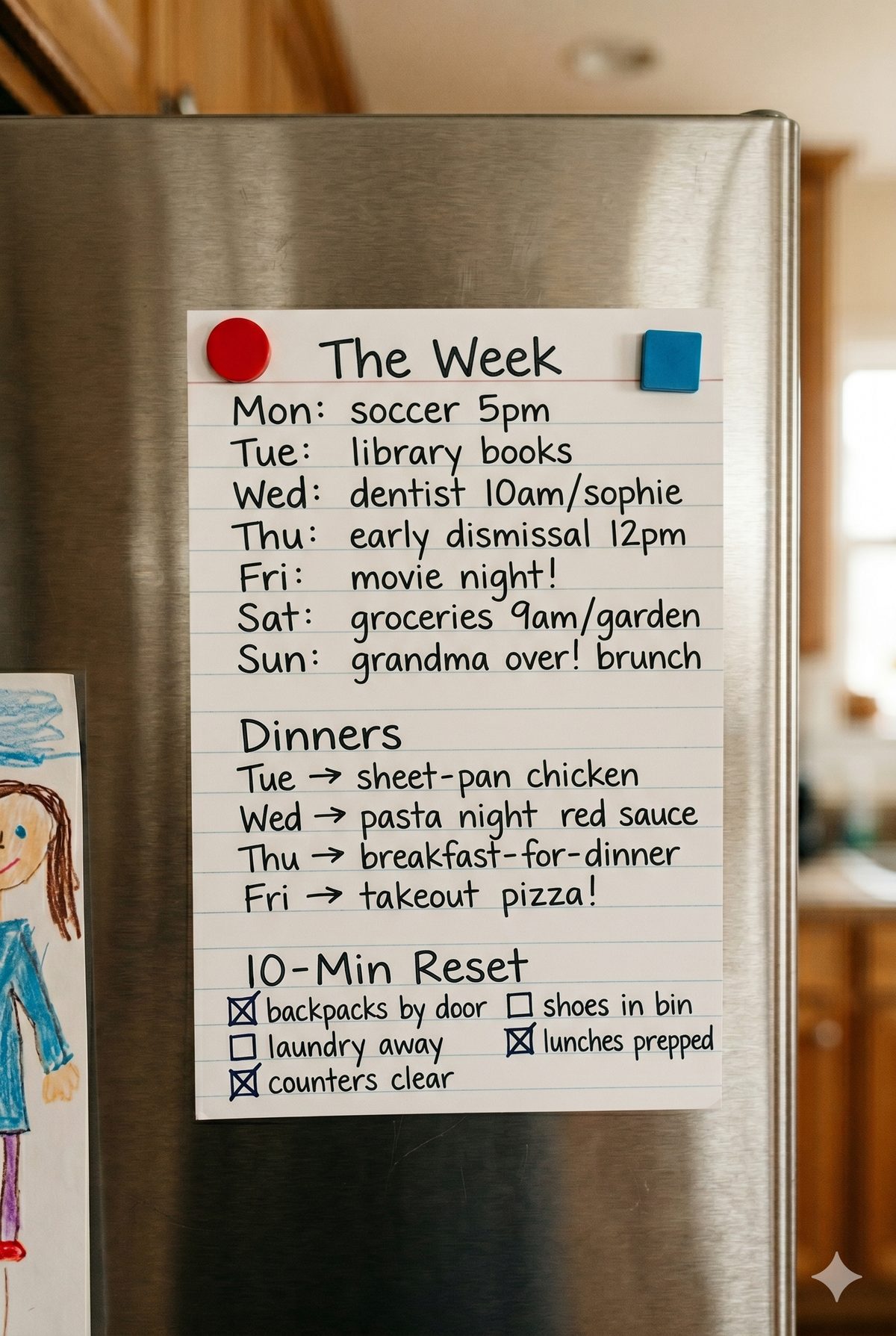
Three moves, in order: surface the week, plan the food, reset the space. That’s the whole thing.
Surface the week means everybody’s commitments land on one shared surface, so the Thursday dentist appointment stops being a Thursday-morning surprise. Plan the food means deciding what dinner is on the nights that are tight, before 5
on a Tuesday decides for you. Reset the space means ten minutes of putting the house back to a neutral start so Monday doesn’t begin in a hole.None of it is complicated. The hard part is doing it on the same day every week, when nothing’s on fire yet. That’s also the entire point.
Step One: Empty Everyone’s Week Onto One Surface
Get every commitment out of everyone’s head and onto one thing the family can see. A wall calendar, a whiteboard, a sheet of paper taped to the fridge. The surface matters less than the rule: if it’s not on the surface, it doesn’t exist.
Go person by person, day by day. Practices, games, the work thing that bleeds into pickup, the half-day at school nobody flagged, the birthday party that needs a gift bought first. Say each one out loud as it goes up. Kids old enough to have their own stuff should report their own stuff. A nine-year-old who puts their own game on the board is a nine-year-old who’s slightly less shocked when Saturday comes.
The win here is small and enormous at the same time. Most week-wrecking chaos isn’t a real emergency. It’s a known thing nobody said out loud in time.
Step Two: Pick the Meals Before the Meals Pick You
The 5
“what’s for dinner” scramble is the single most reliable way to blow up a weeknight. Decide on Sunday and it mostly disappears.You don’t need seven plated dinners. You need a plan for the three or four nights that are actually tight. Look at the surface from step one: the night with back-to-back practices is a sheet-pan or a breakfast-for-dinner night, not the night to try a new recipe. The wide-open Wednesday can carry the meal that needs time at the stove. Match the food to the night instead of pretending every night has the same hour to spare.
Write the meals down where the food happens. The kitchen, not a phone that’ll get closed and forgotten. The rule of thumb that survives: plan the hard nights, leave the easy ones loose, and keep one no-cook fallback for the night that goes sideways anyway.
Step Three: The Ten-Minute House Reset
Not a deep clean. A reset. The goal is a neutral starting line, not a magazine spread.
Set a timer for ten minutes and everyone resets one zone. Backpacks loaded for Monday and parked by the door. Clean laundry actually in drawers instead of auditioning as furniture on a chair. Counters cleared enough that breakfast has somewhere to happen. Kids each take a zone by age: a four-year-old can put shoes in a bin, a ten-year-old can run the whole entryway.
When the timer goes, you’re done, even if it’s not perfect. Perfect was never the assignment. A house that starts the week at neutral instead of in a hole, that’s the assignment, and ten honest minutes gets you there.
Where the Sunday Issue Comes In
Everything above runs on a pen and an index card. It genuinely does. The catch is that drawing the grid every single week, remembering the meal columns, keeping the checklist consistent, is itself a small chore that quietly erodes until one Sunday you just skip it. And a skipped reset is how you wind up back at the Tuesday 5
fog.That gap is what the Poopin’ Papers Sunday issue fills. It’s the reset, already laid out. The week’s grid, a spot to plan the meals, the chore checklist sorted by zone, plus the jokes and the one-word coaching nudge that make kids actually want to read the thing on the fridge. You could redraw it yourself every Sunday. Or it shows up done, and the only job left is filling in your own week.
The reset is the habit. The issue is the thing that keeps the habit from dying in week three.
Want the Sunday reset to show up already done? Get the Poopin’ Papers Sunday issue in your inbox every week.
None of this requires being a naturally organized person. It requires thirty minutes and the same thirty minutes every week. Pick a time, surface the week, plan the tight nights, reset the space. Monday stops being an ambush.
Or skip it, and meet Tuesday at 5
the hard way.